 ACCESS


Prepare for IELTSEN
About JSAF as an Official IELTS Test Centre in partnership with IDP Education

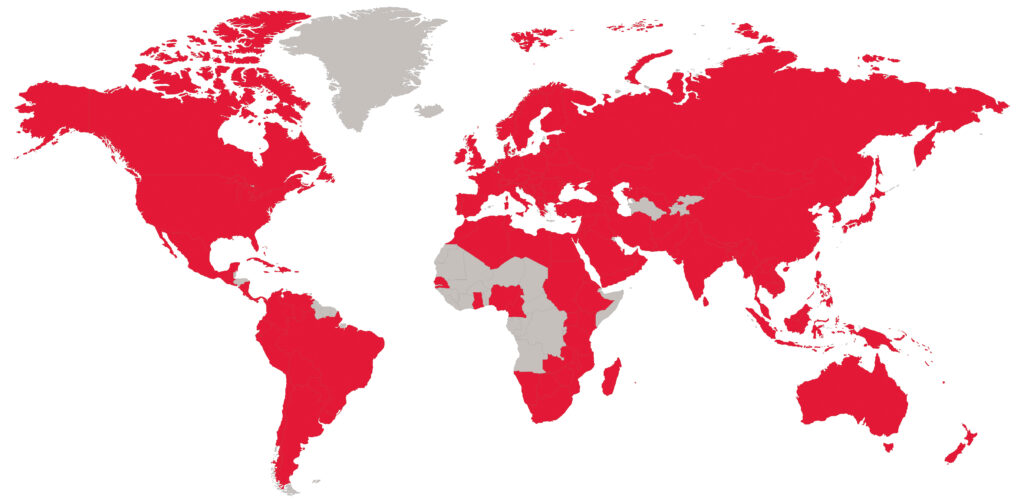
In May 2016, JSAF established a new partnership with IDP: IELTS Australia, a subsidiary of IDP Education, https://www.idp.com/global/ielts. IDP Education is a global leader in English language testing and training and student placement services. IDP: IELTS Australia is a co-owner of IELTS with the British Council and Cambridge Assessment English. It manages English language test centres in 50 countries and supports more than 10,000 universities, governments, professional bodies and employers that accept IELTS results. Our partnership with IDP: IELTS Australia opens the door for more opportunities and customer centred services in Japan for IELTS test-takers. JSAF, with comprehensive support from IDP: IELTS Australia, will provide IELTS testing services at various venues in Japan. The combination of IELTS and Study Abroad programmes will strengthen JSAF and enable us to provide more global opportunities for Japanese people.
What is IELTS?
The international English language testing system (IELTS) is the world’s most popular high stakes English language test with over 3 million test takers in the past year, accepted for study, work and migration. IELTS is designed to assess the four English language skills — listening, reading, writing and speaking, which you will be using if you study, work, or live abroad.
Test Format
IELTS on Computer and IELTS on Paper
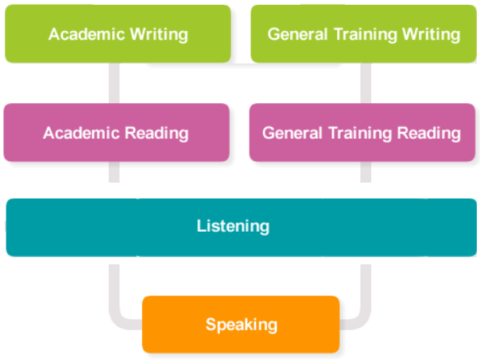
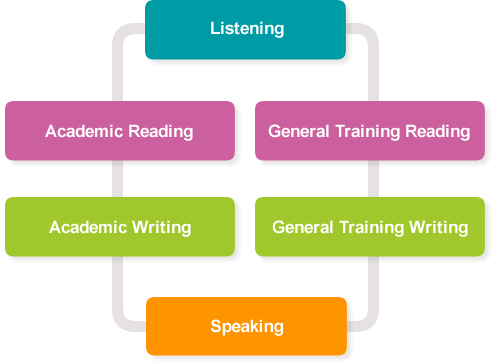
If you choose to take IELTS on computer, you will take the Listening, Reading and Writing test using a computer. If you choose to take IELTS on paper, you will complete the Writing, Reading and Listening test on paper. The Speaking test is always face to face with an examiner whether you take the test on paper or on computer.
All aspects of the tests are identical, including:
- Test Report Form
- Question types
- Content
- Timings
- Marking
*The order of the test is different for IELTS on Paper and IELTS on Computer.
IELTS on paper
IELTS on computer
IELTS Academic and IELTS General Training
IELTS offers a choice of two versions: IELTS Academic and IELTS General Training. Both versions comprise four separate parts that assess each of the four language skills – listening, reading, writing and speaking. Your choice of either version depends on the organisation you are applying to and your plans for the future. The version of the test you take – and the score you need – will depend on both your visa requirements and the requirements of the institution where you plan to study or work. Both versions of the test include the same Listening and Speaking components and different Reading and Writing components.
IELTS Academic
IELTS Academic measures English language proficiency needed for an academic, higher learning environment. The tasks and texts are accessible to anyone, irrespective of your subject focus. The Academic format is, broadly speaking, for those who want to study or train in a university that teaches in English at undergraduate or postgraduate level, or institutions of higher and further education. Many professions (e.g. medical, nursing, accounting, engineering) also require an Academic test result for registration purposes in many countries.
IELTS General Training
IELTS General Training measures English language proficiency in a practical, everyday context. The tasks and texts reflect both workplace and social situations. The General Training version of the test is typically for those who are going to English-speaking countries to do secondary education, work experience or training programs. This version of the test is also often a visa requirement if you are planning to migrate to English speaking countries including Australia, the UK, Canada and New Zealand.

7 Reasons Why IELTS is No. 1

1. Accepted
IELTS results are requested by universities and employers in many countries, including US, Canada, UK, Australia, New Zealand and Ireland. IELTS results are also requested by professional bodies, immigration authorities and other government agencies in the Middle East and across the world. IELTS is recognised by more than 10,000 institutions over 140 countries. Click here to see who accepts IELTS.
2. Available
Up to 48 test dates per year at over 1,100 test locations worldwide
3. Fair
The test that gives you a better chance to do your best. Take your speaking test one-to-one with an examiner. No computers, no interruptions.
4. Fast
Total IELTS test time is under 3 hours and you get your IELTS results after just 1-5 days (IELTS on Computer).
5. Respected
IELTS is co-owned and was co-created by a global partnership of education and language experts: the British Council, IDP: IELTS Australia and Cambridge Assessment English.
6. Relevant
Preparing for IELTS helps you improve the language skills you will need to succeed in your studies and work overseas.
7. International
IELTS accepts British and American spellings and a variety of accents are used during the test.
On the Test Day
What to Expect on Test Day
The IELTS test has four components. Three components − Listening, Reading and Writing − are always taken on the same day, in the same session. The Speaking component may be sat the same day or taken up to seven days before or after the other tests, depending on your test centre. The IELTS test implements sophisticated, biometric security measures which protect test takers and organisations from attempts to cheat. You will go through the processes described below when you register on test day.
Arrive early
You should arrive early for your IELTS test in order to allow time for you to register and be seated for the test. Please refer to your booking confirmation for details. If you arrive late, you may not be allowed to take the test.
Personal items
No personal items are to be taken into the test room including mobile phones, cameras, watches, hats, scarves, wallets, books or notes.
ID check
When you register on test day, a staff member will check your passport. Your passport must be the same passport that you used when you booked the test. It must also be valid (unexpired) and have a recognisable photo of yourself. As a secure, high-stakes test, IELTS uses the latest biometric technology to verify your identity and to reduce your waiting time on test day. This means that on the day of your test we will capture your high-resolution photograph to include on your Test Report Form (TRF). We also ask for your finger scan as further measure of your identity. Each time you re-enter the test room (after a toilet break or for your Speaking test), your identity will be verified by simply asking you to scan your finger.
Entering the test room
When it is time to enter the test room, an invigilator will guide you to your seat. You are not permitted to speak to any other test takers in the test room. If you have a question, raise your hand and an invigilator will assist you. On your desk, you are only allowed to have your passport and a bottle of water in a transparent bottle. Once seated, you are not permitted to leave the test room during the last 10 minutes of any of the test components. If you need to leave the test room to go to the bathroom at any other time, raise your hand and ask an invigilator.
During the test
If you have a problem during the test (for example, if you think you have been given the wrong question booklet, you cannot hear the instructions clearly, or you feel ill) raise your hand and an ivigilator will assist you. Remember that invigilators will not provide any explanation on the questions. You cannot leave your seat until your papers have been collected and you have been told to leave. If you finish the test early you must wait quietly until the test is finished and you are advised that you can leave.
After the test
Collect your personal belongings. Your provisional results will be available online 13 calendar days after the test for IELTS on paper and 1-5 days after the test for IELTS on Computer. Your official result will appear on your Test Report Form which will also be ready after 13 calendar days and 1-5 days, respectively. Your Test Report Form will be posted to you.
Test day advice
On the day of your test you must:
- Arrive early
so that you have enough time to check in and move through all necessary security procedures. - Bring your valid passport
You must have the same passport that you used when you booked the test. If you do not have the correct passport, you will not be able to take the test. - Try to stay calm
so you can do your best in the test. - Listen carefully
to the test supervisor’s instructions. If you cannot hear or are unsure, raise your hand and the supervisor will assist you.
Remember:
- You must not cheat, copy the work of another test taker or disrupt the test.
- You must not use, or try to use, a dictionary, pager, spell-checker, electronic recorder or mobile phone.
- You may not lend anything to or borrow anything from another person once you have entered the test room.
- The supervisor cannot help you with any of the test questions.
- You must not talk to, or disturb, other test takers once the test has started.
- You are not allowed to eat or smoke in the examination room.
- You must not reproduce any part of the test. You will have your test results withheld and be liable to prosecution if you do this.
- Do not take any materials from the examination room. This includes test papers, answer papers, working paper or any other test materials.
- You cannot leave the examination room without permission from a supervisor.
If you are caught breaking any of these rules, your test result will be withheld and the institution or professional body you may have nominated to receive your results will be notified.
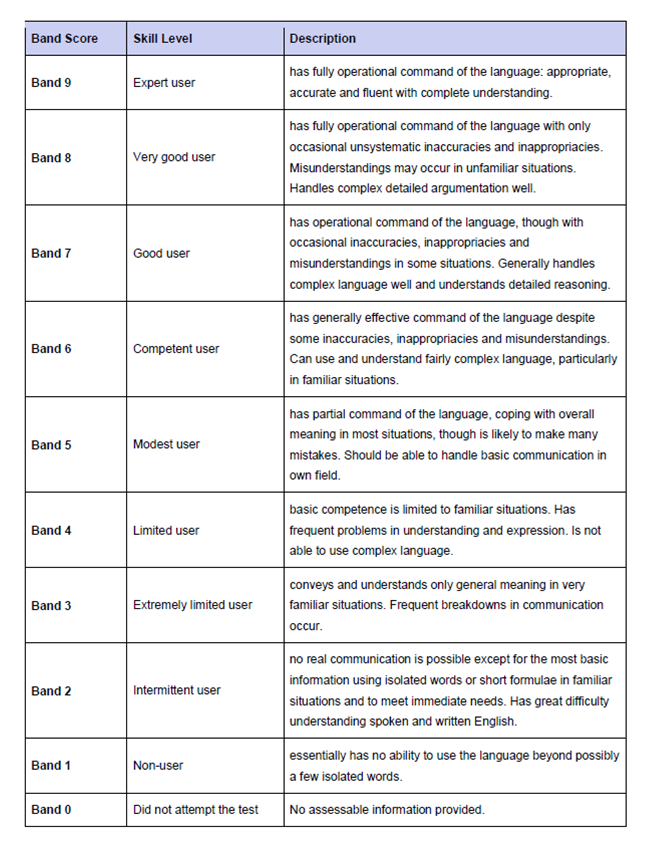
Band Score
Who Accepts IELTS Scores
https://www.ielts.org/about-the-test/who-accepts-ielts-scores
Organisations in the USA / USA accepts IELTS
More than 3,000 American Institutions trust IELTS as proof of the English language proficiency abilities of non-native speakers who wish to study or work in the USA. See below for a list of available services and resources for educational institutions and organisations in the USA that accept IELTS.
https://www.ielts.org/usa/ielts-in-the-usa/ielts-for-organizations-in-the-usa
Book Your Test
Please prepare for upload a scan or image of your passport (showing your photo and signature) that is valid on the day of the exam and save it on your computer or device. If the image size is too large, you may not be able to upload it.
*Please note that driver licenses and student IDs are not accepted as valid IDs. You must upload a copy of your valid passport.
Image specs:
- Number of pixels: minimum 800 X 700 pixels
- Size: less than 1.5MB
- File Format: tiff, jpg, doc, docx, pdf, png, gif, jpeg
- Color
2. A credit card or other payment method to pay the test fee
Test fee in Japan: 27,500 yen (IELTS on Computer and Paper).
Payment options: Credit card payment and convenience store payment options are available, depending on the test centre.


